
French crop vs. textured fringe
A French crop is a short haircut worn forward with a compact fringe. A textured fringe describes a piecey front that can sit on a short crop or a longer top. You can ask for both. The choice is how much forehead to show and whether the ends should form a clear line or break into pieces.
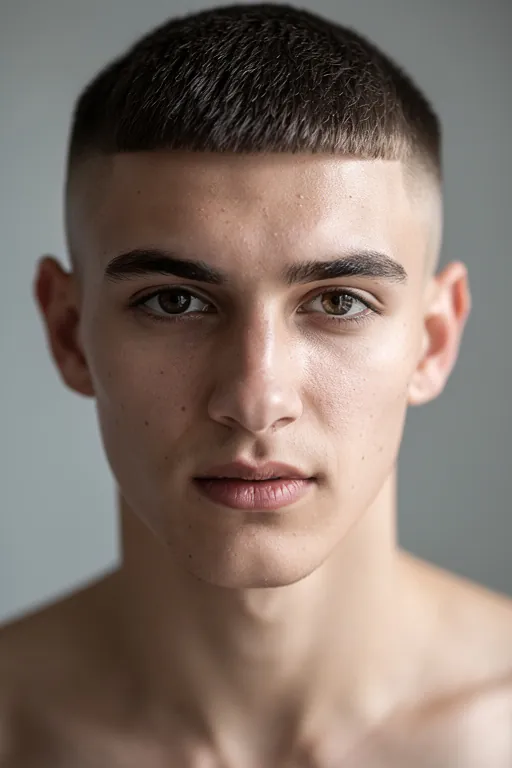
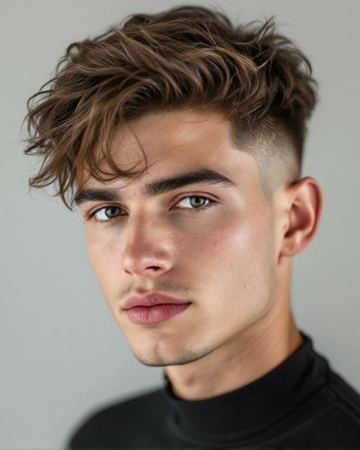
AI catalog illustrations. Compare the front edge independently of the side lengths.
Set the lowest point before choosing the texture
Stand in front of a mirror with your hair dry and brush the front forward. Hold one finger horizontally where you want the lowest piece to land. A fringe high on the forehead makes even a small bend in the edge easy to see. A longer fringe gives the barber room to alternate short and long pieces, but you may find yourself moving it off your brows.
Now look at the corners. A full, level corner makes the fringe look more graphic. A shorter or broken-up corner opens the temple. You can keep the center about the same length in both cuts and get a different result just by changing those corners.
Does your hair want to fall forward?
If one side lifts as soon as you comb it down, show that movement before your hair is wet. A short fringe can stand up at a cowlick. A little more length gives your barber room to work with the lift or let a deliberate gap sit there. On waves and curls, agree on the lowest point after the front springs back.
For dense hair that sits like a shelf above your forehead, ask where weight can be removed behind the fringe. For fine hair that separates easily, keep enough strands together at the ends. Cutting lots of short pieces into an already sparse edge can leave wider gaps than the reference shows.
What to ask your barber
“For the crop, bring the top forward. I want the fringe to end here, well above my brows, with a mostly even edge. Leave a little softness at the corners.”
“For the textured fringe, keep the longest pieces just above my brows when dry. I want to separate them with my fingers. Leave some weight over the cowlick and keep the same short sides.”